







Cream
Tretinoin Cream
Topical retinoid cream for wrinkles, acne, and photoaging. Prescription-strength skin renewal.
Starting at $129/mo

Skin
Tretinoin, acne, brightening and peptide formulas compounded for your skin, prescribed by a licensed physician and shipped to your door.
Find your treatmentReal products and real prices from our pharmacy. Your physician helps you choose the formula and the strength.
Cream
Topical retinoid cream for wrinkles, acne, and photoaging. Prescription-strength skin renewal.
Starting at $129/mo
Cream
Acne treatment combining antibiotics (clindamycin/erythromycin/ketoconazole) with tretinoin for faster clearance and post-acne healing.
Starting at $139/mo
Cream
Classic Kligman formulation combining depigmenting, retinoid, and anti-inflammatory agents. Gold standard for melasma.
Starting at $129/mo
Injection
A naturally occurring copper peptide studied for skin repair, firmness and healthy aging. Prescribed and dosed by a licensed physician.
Starting at $209/mo
Injection
GHK-Cu for skin and tissue repair paired with Epithalon for cellular aging, in one longevity-focused vial. Prescribed and dosed by a licensed physician.
Starting at $229/mo
Cream
Triple-action topical for acne: antibiotic (clindamycin + erythromycin) and antifungal (ketoconazole). Covers bacterial and fungal acne.
Starting at $139/mo
Cream
Stronger prescription cream for stubborn melasma and dark spots: hydroquinone 6% with tretinoin, hydrocortisone, kojic acid and vitamins C and E. A short course, usually up to 8 weeks.
Starting at $149/mo
Cream
Acne and post-acne formula combining azelaic acid, niacinamide, clindamycin, and tretinoin. Anti-inflammatory and cell-renewing.
Starting at $149/mo
Cream
Brightening and anti-inflammatory cream combining azelaic acid, hydroquinone, kojic acid, tranexamic acid, and niacinamide. For post-acne hyperpigmentation.
Starting at $149/mo
Capsule
Oral antibiotic (tetracycline) for acne and rosacea at low anti-inflammatory doses. Available as capsules and tablets.
Starting at $99/mo
Topical retinoids like tretinoin are a first-line treatment for acne and the best-studied topical for sun-damaged skin. Hydroquinone is a standard treatment for dark spots and melasma.
They work, but they ask for patience and care: the first weeks can bring dryness and peeling, and daily sunscreen is part of the treatment.
See the treatments
Retinoids clear clogged pores and help prevent new ones; it takes about two to three months.

Fine lines and rough texture improve gradually with months of steady use.

Brightening formulas fade dark spots over weeks to months, alongside sunscreen.

Your physician starts low and adjusts the strength as your skin adapts.
Individual results vary. Prescription products require an online evaluation with a licensed medical professional who will determine if a prescription is appropriate.
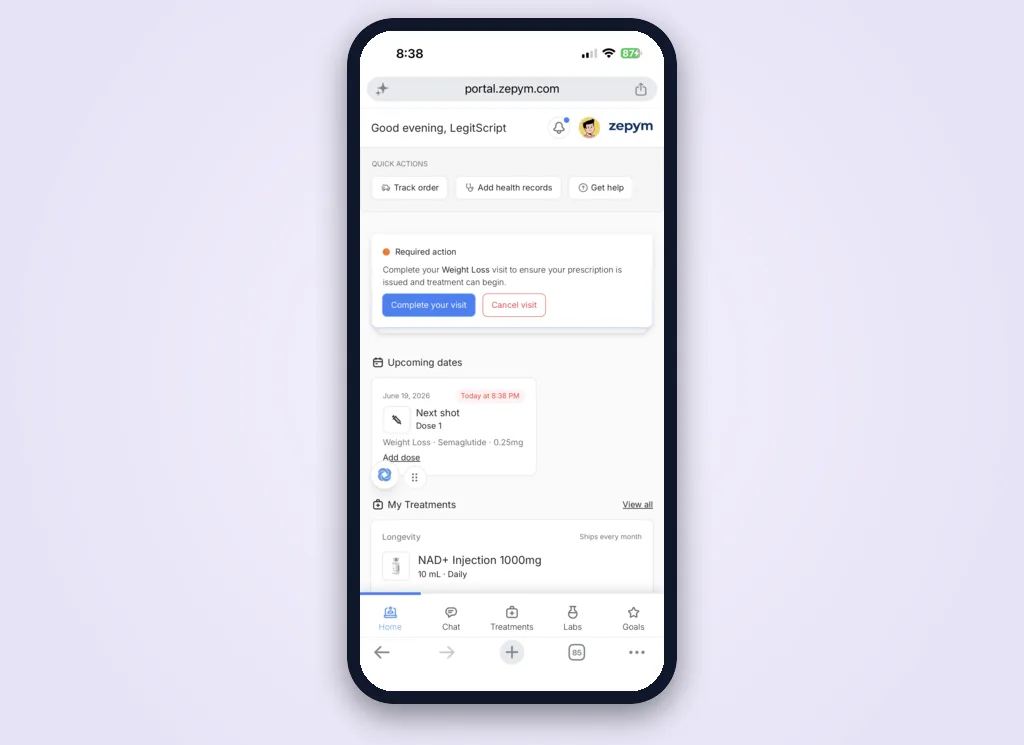
Step 1
Answer a few questions and share photos of your skin. A licensed physician reviews them.

Step 2
Start slowly, a few nights a week. Dryness and peeling are common as skin adjusts.

Step 3
Breakouts calm and tone starts to even out. Your physician can adjust the strength.

Step 4
Keep going to keep the results, with daily sunscreen and messaging with your care team.
The science
Tretinoin speeds up how skin cells turn over and keeps pores from clogging. Over months it also builds new collagen, which is why it softens fine lines.
It makes skin more sensitive to the sun and is not used during pregnancy. Your physician picks the strength and tells you how to start.
Find your treatmentAcne usually improves in two to three months; fine lines and tone take longer. The first weeks can look worse before they look better.
Yes. Dryness, redness and peeling are common in the first weeks. Using it a few nights a week at first and a gentle moisturizer helps.
Topical retinoids are not used during pregnancy. Tell your physician if you are pregnant, planning to be or breastfeeding.
Yes, every day. Retinoids and brightening creams make skin more sensitive to the sun, and the sun undoes their work on dark spots.
Monthly, every 3 months or every 6 months; longer plans cost less per month. Shipping is free and you can pause or cancel anytime.

Answer a few questions online. A licensed physician reviews them and, if it's right for you, your treatment ships to your door.
From $69/mo

Skin care content medically reviewed by our physician
Scott Nass, MD Doctor of Medicine, board-certified in Family Medicine
Charles R. Drew University and David Geffen School of Medicine at UCLA. Family Medicine residency at Ventura County Medical Center.
| 1 | Guidelines of care for the management of acne vulgaris (American Academy of Dermatology). | J Am Acad Dermatol, 2024 (Reynolds RV et al.) |
Compounded medications are not FDA-approved and the FDA has not reviewed them for safety, efficacy, or quality. Prescription products require an online evaluation with a licensed medical professional who will determine if a prescription is appropriate. Individual results vary.